“Traffic Game-Changer: The Rise and Fall of China’s Hovering Bus!”

Title: “The Rise and Fall of China’s Transit Elevated Bus: A Vision for Urban Transportation”
In the perpetual battle against traffic congestion, Chinese engineers once unveiled an ambitious solution: the Transit Elevated Bus (TEB). This groundbreaking concept promised to revolutionize urban transportation by hovering above regular road traffic, allowing cars to pass underneath. Let’s delve into the journey of the TEB, from its innovative design to its eventual abandonment.
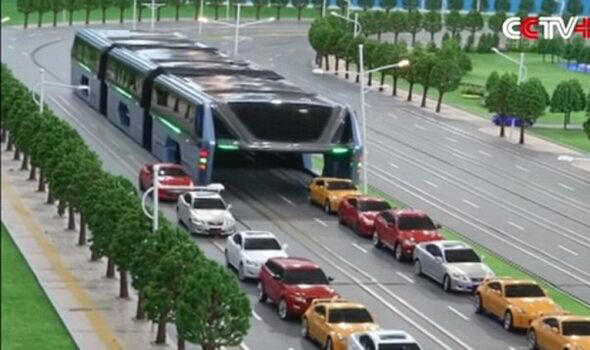
The TEB, showcased at the 19th China Beijing International High-Tech Expo in 2016, captured imaginations worldwide. Resembling a hybrid between a tram and a bus, this futuristic transport system boasted the capacity to carry up to 1,200 passengers, maximizing road space and potentially reducing traffic congestion. Its design, featuring a set of fixed rails embedded in the road, aimed to offer an alternative to traditional buses while minimizing construction costs.
With an estimated cost of £3.5 million per unit, the TEB garnered attention for its promise of efficiency. Bai Zhiming, the engineer spearheading the project, highlighted its similarities to subway systems but underscored its lower construction costs and faster implementation. The allure of the TEB extended beyond China, with countries like Brazil, France, and India expressing interest in adopting this innovative transportation solution.
Testing on a prototype commenced in August 2016 on a 300-meter-long track, signaling the beginning of a new era in urban transportation. However, the enthusiasm surrounding the TEB was short-lived. By June 2017, the project had been abandoned, leaving many to ponder the reasons behind its demise.
Chinese press reports shed light on the challenges encountered during the TEB’s testing phase. Criticisms ranged from concerns about its sluggish speed and propensity to overheat to difficulties in navigating interactions with other vehicles, particularly cars with roof racks. Moreover, obstacles such as low bridges posed significant impediments to the feasibility of implementing the TEB system on a larger scale.
Despite its initial promise, the TEB ultimately fell short of expectations, highlighting the complexities inherent in innovating within the realm of urban transportation. While the concept captured the imagination of engineers and policymakers alike, its practicality proved elusive in the face of real-world challenges.
 The rise and fall of the TEB serve as a cautionary tale, underscoring the importance of thorough testing and feasibility assessments in the development of ambitious projects. While the allure of groundbreaking innovation is undeniable, it must be tempered by a pragmatic understanding of the practical constraints and operational realities that govern transportation systems.
As we reflect on the legacy of the Transit Elevated Bus, we are reminded of the delicate balance between visionary ambition and practical implementation. While the TEB may have ultimately succumbed to the challenges of its time, its spirit of innovation lives on, inspiring future generations to push the boundaries of what is possible in urban transportation.
In conclusion, the TEB may have been a fleeting dream, but its legacy endures as a testament to the enduring quest for solutions to the ever-present challenge of traffic congestion. As cities around the world grapple with the complexities of urban mobility, the lessons learned from the TEB serve as a reminder of the importance of resilience, adaptability, and a willingness to embrace innovation in pursuit of a brighter future for all.